
Single DVC Subwoofer Series Wiring Diagrams
Single DVC Subwoofer Series Wiring Diagrams
Choose the impedance of each voice coil to see how one dual-voice-coil subwoofer can be wired in series for a 2-ohm, 4-ohm, or 8-ohm final amplifier load.
GUIDES
Find the correct series-wiring diagram
A dual-voice-coil subwoofer has two separate voice coils, and each coil has its own positive and negative terminal. When the coils are wired in series, their nominal impedances are added together. Select the diagram that matches the impedance printed on each voice coil—not the desired final load.
Before selecting a diagram: Check the subwoofer label, product manual, or model specifications to verify whether it has dual 1-ohm, dual 2-ohm, or dual 4-ohm voice coils.
Choose a series-wiring guide
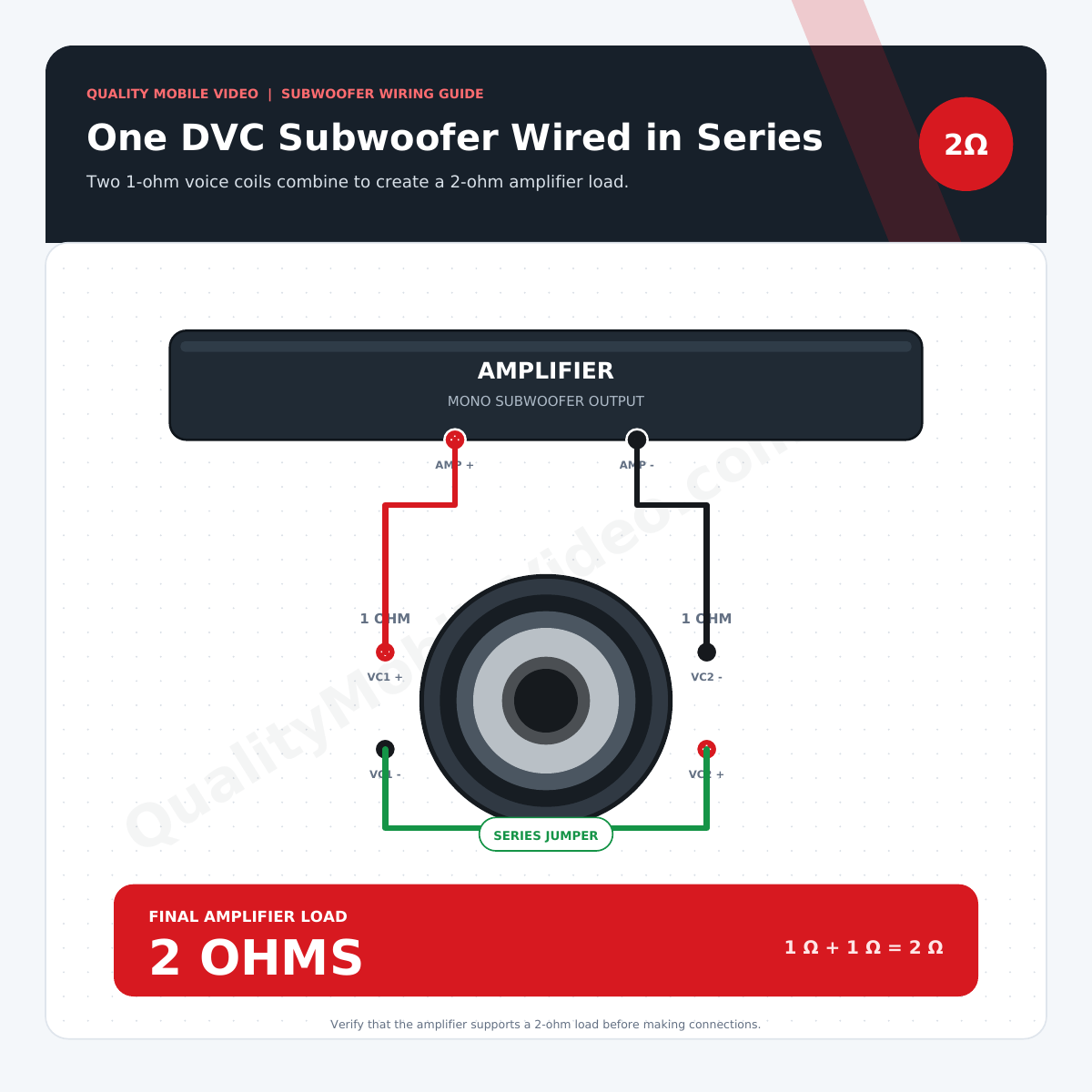
One 1-Ohm DVC Subwoofer
Wire both 1-ohm voice coils in series to present a nominal 2-ohm load to the amplifier.
View the 2-ohm wiring guide →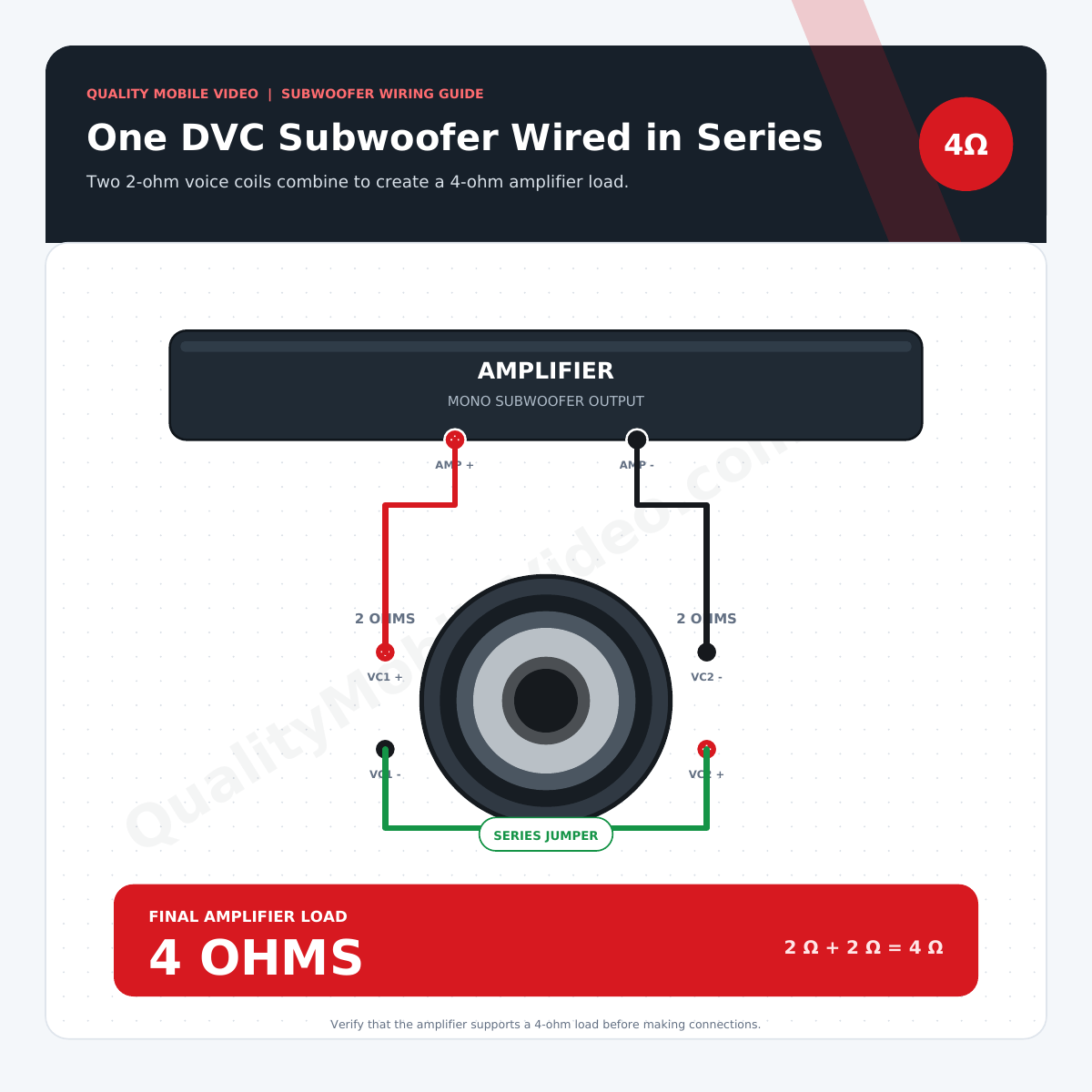
One 2-Ohm DVC Subwoofer
Wire both 2-ohm voice coils in series to present a nominal 4-ohm load to the amplifier.
View the 4-ohm wiring guide →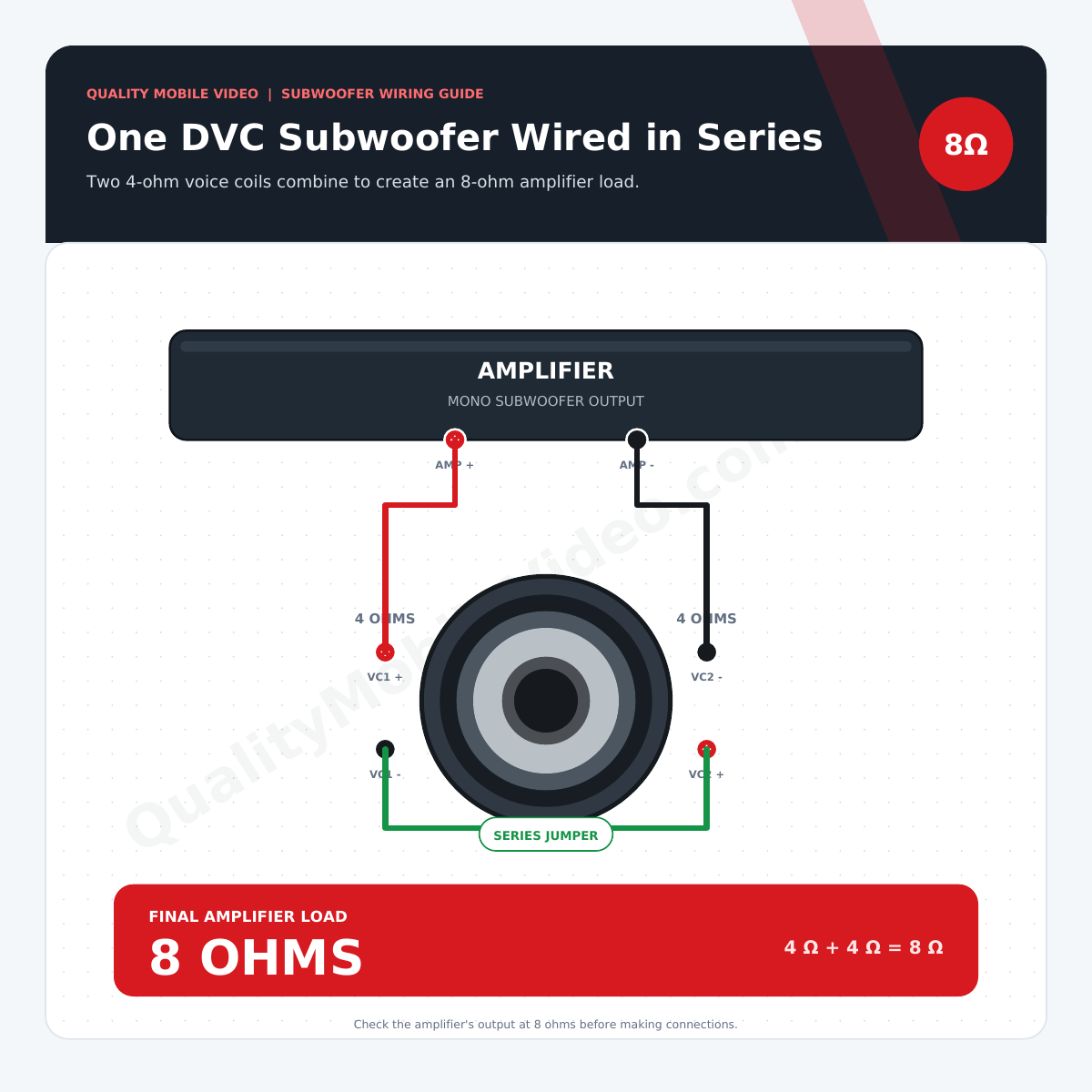
One 4-Ohm DVC Subwoofer
Wire both 4-ohm voice coils in series to present a nominal 8-ohm load to the amplifier.
View the 8-ohm wiring guide →Series-wiring impedance chart
| Subwoofer type | Series calculation | Final amplifier load | Amplifier consideration |
|---|---|---|---|
| Dual 1-ohm DVC | 1Ω + 1Ω | 2Ω | Match the subwoofer to the amplifier’s RMS output at 2 ohms. |
| Dual 2-ohm DVC | 2Ω + 2Ω | 4Ω | Check the amplifier’s RMS output at 4 ohms or its bridged 4-ohm rating. |
| Dual 4-ohm DVC | 4Ω + 4Ω | 8Ω | Expect less amplifier power; verify the 8-ohm output when available. |
How one DVC subwoofer is wired in series
-
01
Verify the voice-coil impedance
Confirm the impedance of each coil from the subwoofer label, manual, or model specifications before making any connections.
-
02
Connect the series jumper
Connect the negative terminal of Voice Coil 1 to the positive terminal of Voice Coil 2 using a short piece of speaker wire.
-
03
Connect the amplifier
Connect amplifier positive to the remaining Voice Coil 1 positive terminal and amplifier negative to the remaining Voice Coil 2 negative terminal.
-
04
Measure before powering up
Use a multimeter across the final speaker leads. DC resistance will normally measure somewhat below the calculated nominal impedance.
Shop subwoofer wiring essentials
Select the correct subwoofer and amplifier first, then use properly sized wire, circuit protection, and signal cables to complete a safe, reliable installation.
Car Subwoofers
Shop subwoofers by size, impedance, power handling, and enclosure type.
Shop subwoofers →Monoblock Amplifiers
Choose a dedicated subwoofer amplifier that matches the final load and RMS power.
Shop mono amplifiers →Speaker Wire
Find stranded speaker wire in the gauge and length required for your installation.
Shop speaker wire →Amplifier Wiring Kits
Get power wire, ground wire, circuit protection, RCA cables, and installation hardware.
Shop amplifier kits →RCA Audio Cables
Use quality shielded interconnects to carry the low-level signal to the amplifier.
Shop RCA cables →Fuses & Power Distribution
Protect the amplifier power cable and distribute current safely throughout the system.
Shop circuit protection →Single-DVC series-wiring FAQ
Does series wiring add the voice-coil impedances?
Yes. For one DVC subwoofer with identical coils, add the nominal impedance of Voice Coil 1 to the nominal impedance of Voice Coil 2.
Why does my multimeter read less than the calculated load?
A multimeter measures DC resistance, while the subwoofer specification is nominal AC impedance. DC resistance is normally lower than the listed nominal impedance.
Can I operate only one voice coil?
Both voice coils should be connected as intended by the manufacturer. Using only one coil can change performance and power handling and may damage the subwoofer.
Is a higher-impedance load safe for my amplifier?
It is generally safe, but the amplifier normally produces less power as impedance rises. Always check its published power specifications and match the resulting RMS power to the subwoofer.
