
How to Wire Two 4-Ohm DVC Subwoofers in Parallel for a 1 ohm load
How to Wire Two 4-Ohm DVC Subwoofers in Parallel
Connect all four 4-ohm voice coils in parallel to create a 1-ohm final load at the amplifier.
What this diagram shows
Each dual-voice-coil subwoofer contains two separate 4-ohm voice coils. With two subwoofers, there are four identical 4-ohm coils. Connecting every positive terminal together and every negative terminal together places all four coils in parallel. For identical loads in parallel, divide one coil’s impedance by the number of coils: 4 ohms divided by four creates a final nominal amplifier load of 1 ohm.
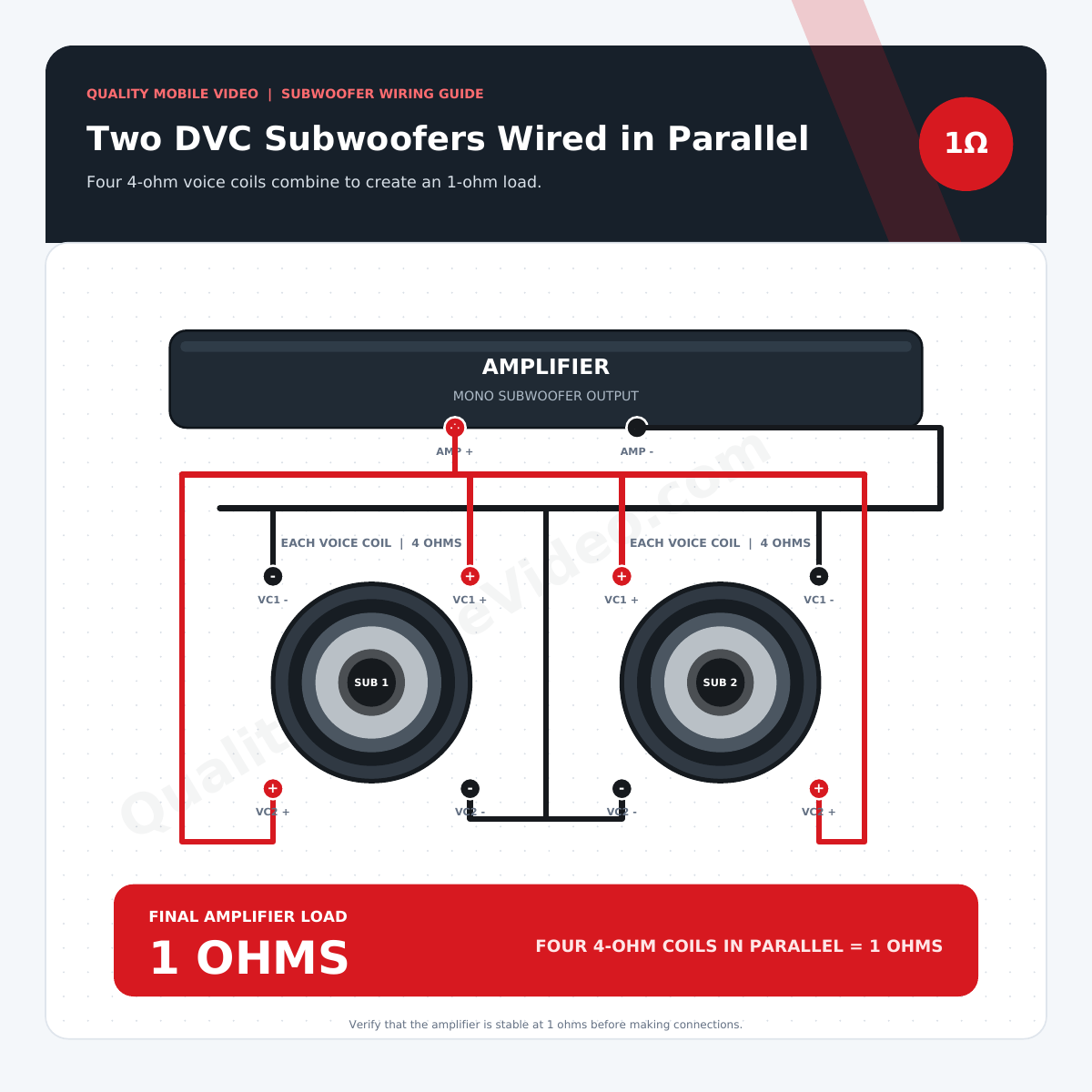
How to wire both DVC subwoofers in parallel
-
01
Turn the system off
Turn off the radio and amplifier, remove the amplifier fuse or disconnect the vehicle battery’s negative terminal, and verify that the amplifier has no power before working on the speaker connections.
-
02
Parallel the coils on Subwoofer 1
Connect both positive voice-coil terminals together, then connect both negative voice-coil terminals together. Use the same speaker-wire gauge for every connection.
-
03
Parallel the coils on Subwoofer 2
Connect both positive voice-coil terminals together, then connect both negative voice-coil terminals together. Verify that no wire strands can touch an adjacent terminal.
-
04
Connect both subwoofers to the amplifier
Join the positive connections from both subwoofers to amplifier positive and join the negative connections from both subwoofers to amplifier negative. Gently pull on every connection to confirm it is secure.
Tips for a reliable connection
Use quality stranded copper speaker wire sized for the amplifier power and wire length. High-current, low-impedance systems may require heavier speaker wire than a typical installation.
Use the same wire gauge and similar wire lengths for both subwoofers so each driver has a comparable connection to the common positive and negative points.
Every positive terminal must connect to the positive bus and every negative terminal to the negative bus. One reversed coil can cause cancellation and possible damage.
This diagram is specifically for two matching DVC subwoofers with four identical 4-ohm voice coils. Do not combine different models or coil impedances in this circuit.
Check the completed wiring with a multimeter
Set the multimeter to its lowest resistance range and measure across the two wires that will connect to the amplifier. A nominal 1-ohm load will normally show a DC resistance somewhat below 1 ohm. Touch the probes together first and note the meter-lead resistance, which can affect a low-resistance measurement. An open or extremely high reading may indicate a missing connection, while an unexpected near-zero reading requires a careful short-circuit inspection.
After the wiring is complete
- Reinstall the amplifier fuse or reconnect the battery only after checking every speaker-wire connection.
- Set amplifier gain with a proper test procedure; the gain control is not a volume knob.
- Start with conservative crossover and bass-boost settings to avoid distortion and unnecessary cone movement.
- Listen at low volume first and check for clean bass, loose connections, unusual heat, or protection-mode shutdowns.
- Secure the enclosure so it cannot move during sudden stops or vehicle maneuvers.
Parallel wiring FAQ
Why does the meter read less than 1 ohm?
The 1-ohm specification is nominal AC impedance. A multimeter measures DC resistance, which is usually lower, and the meter leads can also affect low-resistance measurements.
Can I use this pattern with two 2-ohm DVC subwoofers?
Yes, the connection pattern is the same, but four 2-ohm voice coils wired in parallel create a 0.5-ohm final load, which requires a specialized amplifier.
Can I connect only one voice coil?
All four coils should be connected as intended by the subwoofer manufacturers. Operating only one coil on either subwoofer can change performance and power handling and may damage the driver.
Will the two subwoofers share amplifier power?
Two matching subwoofers with balanced wiring will divide the amplifier’s output approximately equally. Compare half of the amplifier’s RMS output at 1 ohm with the RMS rating of each subwoofer.
